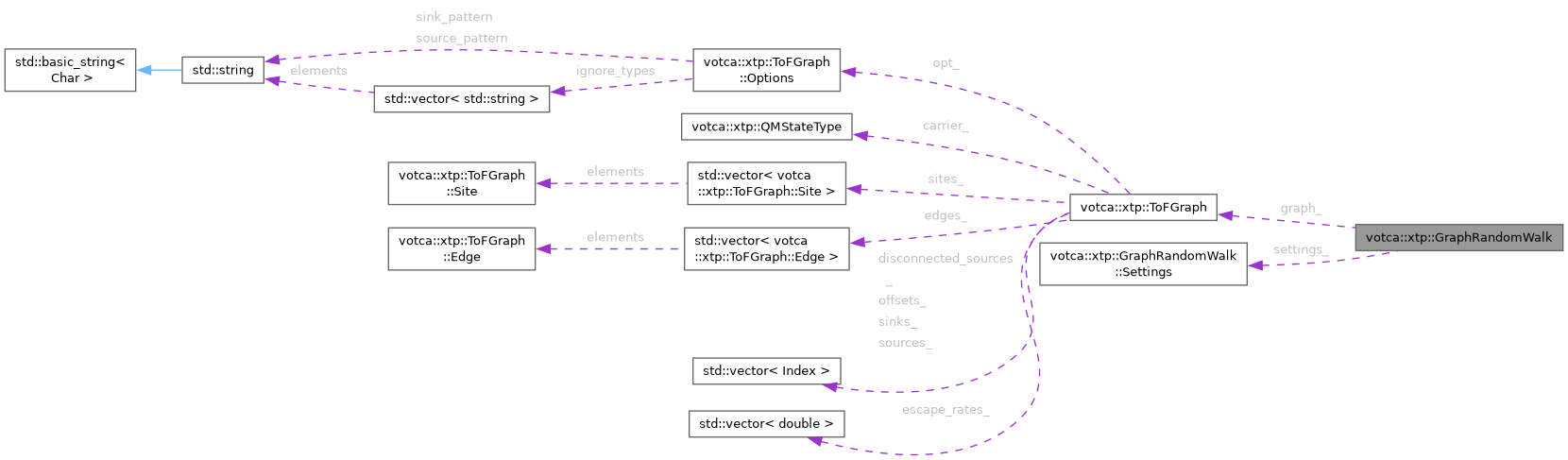
Expected time of flight from hitting times of a continuous-time random walk on a ToFGraph, without sampling (graph random walk, Chen, van der Hoorn, Baumeier, arXiv:2405.15836).
More...
Expected time of flight from hitting times of a continuous-time random walk on a ToFGraph, without sampling (graph random walk, Chen, van der Hoorn, Baumeier, arXiv:2405.15836).
One carrier: the mean hitting times tau of the sink sites solve Q tau = 1, Q = diag(D) - W on the transient sites (all sites except sinks from which a sink can be reached), with D_i the escape rate of site i (hops into sinks included) and W_ij the rate of the hop i -> j. Sinks are not unknowns. The second moment follows from Q m2 = 2 tau, the expected time spent on each site for injection distribution w from the adjoint Q^T g = w.
Two carriers with site exclusion: the unknowns are pairs of occupied transient sites i < j, numbered j(j-1)/2 + i. Hops into an occupied site are not allowed (they enter neither D nor W). Two observables:
- First: time until the first carrier reaches a sink (the paper's definition), Q_PP tau = 1.
- Transit: carriers are removed when they reach a sink, tau is the mean transit time per carrier, (1/2) E[int N(t) dt]. The pair block is the same Q_PP; reaching a sink moves to the one-carrier state of the remaining carrier: Q_PP tau_P = 1 + W_PS tau_S with Q tau_S = 1/2.
If the rates obey detailed balance (ToFGraph::isReversible), Q and Q_PP are similar to symmetric positive definite matrices S = P Q P^-1 with P = diag(exp(-U/2kT)) (for pairs the product of the two sites), solved by sparse Cholesky (LDL^T) or, above Settings::direct_limit unknowns, Jacobi preconditioned conjugate gradients; otherwise sparse LU or BiCGSTAB with incomplete LU. Every solution is refined against Q itself.
The iterative tolerance has to be tight: with energetic disorder the hitting times are dominated by slow (trap) modes that a relative residual of 1e-10 can leave unresolved (7 % error in tau for a 40^3 lattice with sigma = 0.19 eV), hence the default of 1e-14. Direct factorization of graphs from 3D morphologies costs O(n^2) (O(n^2.5) in the pair space), which is why the iterative solvers take over above a few thousand unknowns.
Injection is uniform over the connected source sites (one carrier) or over pairs of them (two carriers). Times are in s.
Definition at line 81 of file graphrandomwalk.h.