Stochastic network model of a molecular charge transport network (Baumeier, Stenzel, Poelking, Andrienko, Schmidt, Phys. Rev. B 86, 184202 (2012); Kordt et al., J. Chem. Theory Comput. 10, 2508 (2014)): a random weighted graph with the statistics of a microscopic (atomistic) system, in a periodic box of any size. More...
#include <stochasticnetwork.h>
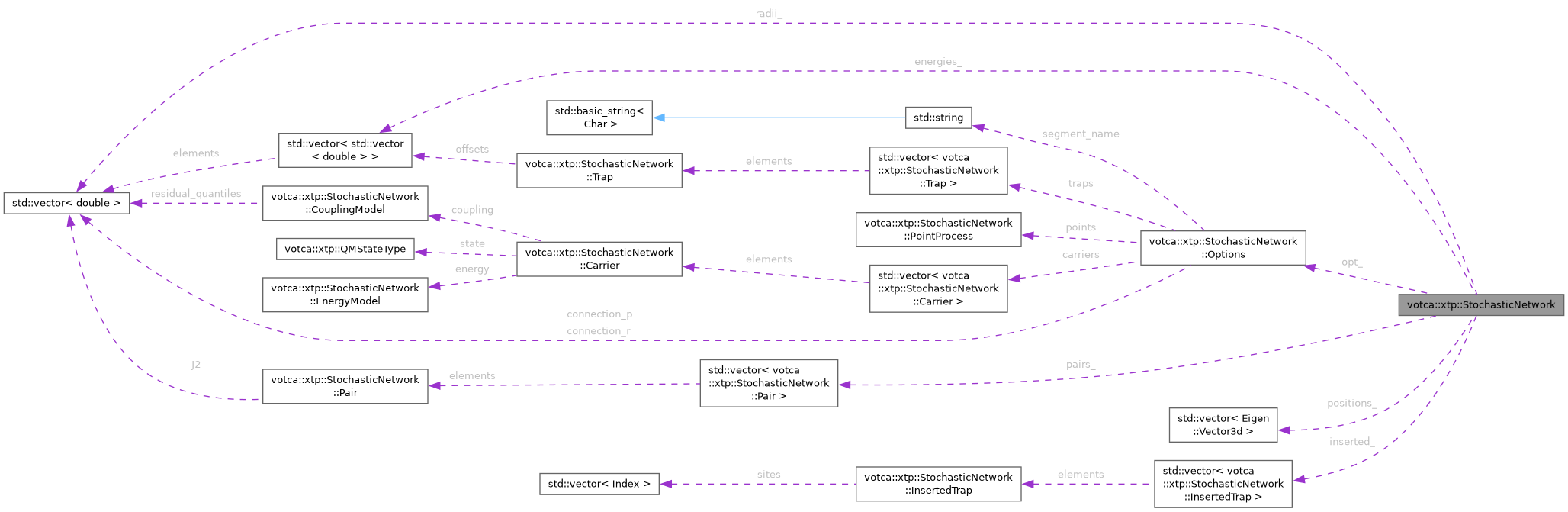
Classes | |
| struct | PointProcess |
| struct | EnergyModel |
| struct | CouplingModel |
| struct | Carrier |
| struct | Trap |
| struct | Options |
| struct | InsertedTrap |
| inserted traps: template index and sites (deepest first) More... | |
| struct | Pair |
Public Member Functions | |
| StochasticNetwork (const Options &opt) | |
| Index | NumberOfSites () const |
| const std::vector< Eigen::Vector3d > & | Positions () const |
| const std::vector< double > & | Radii () const |
| radii of the point process (r_h + X) | |
| const std::vector< InsertedTrap > & | Traps () const |
| const std::vector< double > & | SiteEnergies (Index c) const |
| site energies of carrier c (index into Options::carriers) | |
| const std::vector< Pair > & | Pairs () const |
| Index | Iterations () const |
| iterations the point process needed | |
| void | BuildTopology (Topology &top) const |
| fill an empty topology (segments with one pseudo atom, box, pairs) | |
| double | Connection (double r) const |
| connection probability at distance r (bohr) | |
Static Public Member Functions | |
| static Options | FromProperty (const tools::Property &p) |
| static std::string | ToXML (const Options &opt) |
| the parameter file (root element "stochasticnetwork") | |
| static std::vector< double > | MovingAverage (const PeriodicCells &cells, const EnergyModel &m, Index sites, const std::vector< double > &A, const std::vector< double > &Bf, const std::vector< double > &C) |
| static Index | SamplePoints (const PointProcess &pp, const Eigen::Vector3d &box, Index sites, ModelRandom &random, std::vector< Eigen::Vector3d > &positions, std::vector< double > &radii) |
| static double | Residual (const CouplingModel &m, double g) |
| standardized residual for a standard normal g | |
| static double | Log10J2 (const CouplingModel &m, double r, double g) |
| log10(J^2/eV^2) for distance r (bohr) and standard normal g | |
Private Member Functions | |
| void | Check () const |
| void | GenerateEnergies (ModelRandom &random) |
| void | GeneratePairs (ModelRandom &random) |
| void | InsertTraps (ModelRandom &random) |
Private Attributes | |
| Options | opt_ |
| std::vector< Eigen::Vector3d > | positions_ |
| std::vector< double > | radii_ |
| std::vector< std::vector< double > > | energies_ |
| std::vector< Pair > | pairs_ |
| Index | iterations_ = 0 |
| std::vector< InsertedTrap > | inserted_ |
Detailed Description
Stochastic network model of a molecular charge transport network (Baumeier, Stenzel, Poelking, Andrienko, Schmidt, Phys. Rev. B 86, 184202 (2012); Kordt et al., J. Chem. Theory Comput. 10, 2508 (2014)): a random weighted graph with the statistics of a microscopic (atomistic) system, in a periodic box of any size.
- Sites: iterative dominance-competition point process. Poisson points get radii R = r_h + X with X Gamma distributed (by inversion); a point inside the sphere of a point with a larger radius is removed (all points of an iteration count); later iterations fill the remaining space without violating the spheres of accepted points, until the number of sites is reached.
- Site energies per carrier: moving average of three Gaussian fields, E_i = mean + sigma (sqrt(w_a) A_i + sqrt(w_b/l_b) sum_{N_b(i)} B_j + sqrt(w_c/l_c) sum_{N_c(i)} C_j), N_l(i) the l sites nearest to i, i itself included, w_c = 1 - w_a - w_b. A second carrier can be correlated with the first: z_2 = rho z_1 + sqrt(1 - rho^2) w with w a moving average with the second carrier's parameters.
- Pairs: two sites at distance r are connected with probability f(r) (table, linear interpolation).
- Couplings: log10(J^2 / eV^2) = m(r) + s(r) Q(u), with m and s^2 linear in r and Q the quantile function of the standardized residuals (table; a standard normal if empty), u = Phi(g) for a standard normal g; g of two carriers correlated with coefficient rho_J (Gaussian copula).
- Reorganization and internal energies per carrier: constants.
- Traps (optional): templates of trap sites or clusters from a microscopic system (TrapFinder) are inserted with a density per site: floor(density N) + Bernoulli(rest) traps of each template, each at a random free site and its nearest free sites, whose energies (all carriers) are set to the bulk mean plus the template offsets.
Options are in atomic units (bohr, Hartree) except the coupling model, which is in log10(J^2 / eV^2) per nm as in the papers.
Definition at line 142 of file stochasticnetwork.h.
Constructor & Destructor Documentation
◆ StochasticNetwork()
|
explicit |
Definition at line 271 of file stochasticnetwork.cc.
Member Function Documentation
◆ BuildTopology()
| void votca::xtp::StochasticNetwork::BuildTopology | ( | Topology & | top | ) | const |
fill an empty topology (segments with one pseudo atom, box, pairs)
Definition at line 731 of file stochasticnetwork.cc.
◆ Check()
|
private |
Definition at line 289 of file stochasticnetwork.cc.
◆ Connection()
| double votca::xtp::StochasticNetwork::Connection | ( | double | r | ) | const |
connection probability at distance r (bohr)
Definition at line 576 of file stochasticnetwork.cc.
◆ FromProperty()
|
static |
options from a parameter file written by networkfit (units nm, eV); sites and box are left as in the file and can be overwritten
Definition at line 763 of file stochasticnetwork.cc.
◆ GenerateEnergies()
|
private |
Definition at line 540 of file stochasticnetwork.cc.
◆ GeneratePairs()
|
private |
Definition at line 680 of file stochasticnetwork.cc.
◆ InsertTraps()
|
private |
Definition at line 633 of file stochasticnetwork.cc.
◆ Iterations()
|
inline |
iterations the point process needed
Definition at line 237 of file stochasticnetwork.h.
◆ Log10J2()
|
static |
log10(J^2/eV^2) for distance r (bohr) and standard normal g
Definition at line 626 of file stochasticnetwork.cc.
◆ MovingAverage()
|
static |
standardized moving average z_i (unit variance) of the standard normal fields A, B, C (one value per site); E_i = mean + sigma z_i
Definition at line 507 of file stochasticnetwork.cc.
◆ NumberOfSites()
|
inline |
Definition at line 215 of file stochasticnetwork.h.
◆ Pairs()
|
inline |
Definition at line 235 of file stochasticnetwork.h.
◆ Positions()
|
inline |
Definition at line 216 of file stochasticnetwork.h.
◆ Radii()
|
inline |
radii of the point process (r_h + X)
Definition at line 218 of file stochasticnetwork.h.
◆ Residual()
|
static |
standardized residual for a standard normal g
Definition at line 598 of file stochasticnetwork.cc.
◆ SamplePoints()
|
static |
one realization of the point process (as used by the constructor); returns the number of iterations, throws if the box is saturated
Definition at line 376 of file stochasticnetwork.cc.
◆ SiteEnergies()
|
inline |
site energies of carrier c (index into Options::carriers)
Definition at line 226 of file stochasticnetwork.h.
◆ ToXML()
|
static |
the parameter file (root element "stochasticnetwork")
Definition at line 851 of file stochasticnetwork.cc.
◆ Traps()
|
inline |
Definition at line 224 of file stochasticnetwork.h.
Member Data Documentation
◆ energies_
|
private |
Definition at line 272 of file stochasticnetwork.h.
◆ inserted_
|
private |
Definition at line 275 of file stochasticnetwork.h.
◆ iterations_
|
private |
Definition at line 274 of file stochasticnetwork.h.
◆ opt_
|
private |
Definition at line 269 of file stochasticnetwork.h.
◆ pairs_
|
private |
Definition at line 273 of file stochasticnetwork.h.
◆ positions_
|
private |
Definition at line 270 of file stochasticnetwork.h.
◆ radii_
|
private |
Definition at line 271 of file stochasticnetwork.h.
The documentation for this class was generated from the following files:
- xtp/include/votca/xtp/stochasticnetwork.h
- xtp/src/libxtp/stochasticnetwork.cc
