#include <threecenter.h>

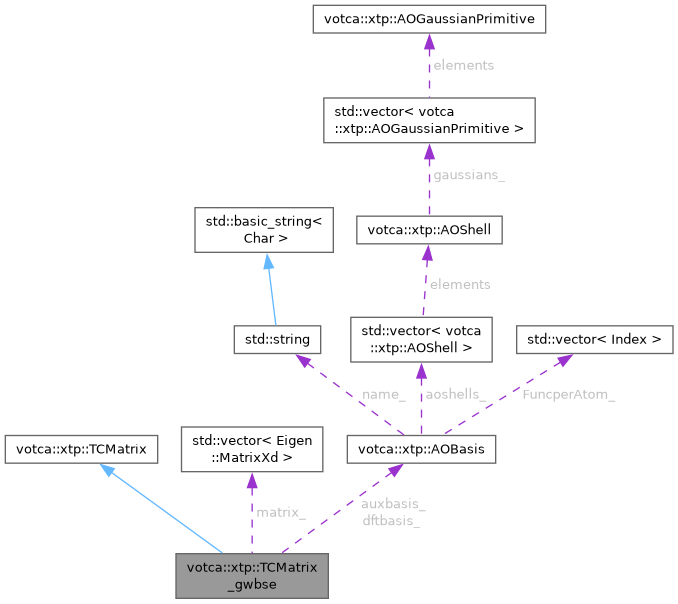
Classes | |
| struct | ResponsePoint |
| A response the RPA adds to its own sum over these integrals, epsilon(w) = 1 + X[M](w) + F^T Y(w) F, given in the fill-time frame (F = AuxFrame()) at fixed frequencies: the static response of a part of the system that is not in M, e.g. the inactive region of a projection-based embedding (InactiveScreening). Survives Fill and Rebuild (same auxiliary basis, same metric). The RPA throws when it is asked for epsilon at a frequency that has no Y. More... | |
Public Member Functions | |
| const Eigen::MatrixXd & | operator[] (Index i) const |
| Eigen::MatrixXd & | operator[] (Index i) |
| Index | auxsize () const |
| Index | get_mmin () const |
| Index | get_mmax () const |
| Index | get_nmin () const |
| Index | get_nmax () const |
| Index | msize () const |
| Index | nsize () const |
| void | Initialize (Index basissize, Index mmin, Index mmax, Index nmin, Index nmax) |
| void | Fill (const AOBasis &auxbasis, const AOBasis &dftbasis, const Eigen::MatrixXd &dft_orbitals) |
| void | Fill (const AOBasis &auxbasis, const AOBasis &dftbasis, const Eigen::MatrixXd &dft_orbitals, const Eigen::MatrixXd &inv_sqrt) |
| void | Rebuild () |
| void | MultiplyRightWithAuxMatrix (const Eigen::MatrixXd &matrix) |
| void | MultiplyRightWithAuxMatrixLeading (const Eigen::MatrixXd &U, Index full_slices, Index lead) |
| Rotate the auxiliary index of only the part of the tensor a consumer reads: all rows of slices [0, full_slices) and the first lead rows of slices [full_slices, lead). | |
| bool | PartiallyRotated () const |
| Whether only a leading part was rotated since the last Fill. | |
| const Eigen::MatrixXd & | InvSqrt () const |
| const Eigen::MatrixXd & | AuxFrame () const |
| void | RestoreAuxFrame (const Eigen::MatrixXd &frame) |
| Eigen::MatrixXd | ToCurrentAuxFrame (const Eigen::MatrixXd &K) const |
| bool | AuxFrameIsOrthogonal () const |
| void | DressAuxIndex (const Eigen::MatrixXd &S) |
| Dress the auxiliary index with S: M_fill -> M_fill S. | |
| void | UndressAuxIndex () |
| bool | Dressed () const |
| const Eigen::MatrixXd & | Dressing () const |
| S of the current dressing (empty if bare). | |
| void | setAdditionalResponse (std::vector< ResponsePoint > points) |
| bool | HasAdditionalResponse () const |
| Eigen::MatrixXd | AdditionalResponse (bool imaginary, double frequency) const |
| F^T Y F at this frequency, in the frame operator[] is in now. | |
| void | setAdditionalPoles (Eigen::VectorXd energies, Eigen::MatrixXd vectors) |
| A response given as poles, in the form of transitions: Y(i w) = sum_k 4 W_k/(W_k^2 + w^2) c_k c_k^T, with energies W_k and vectors c_k (columns, fill-time frame). The RPA treats each pole as one more transition with energy W_k and integrals c_k: in epsilon at any frequency, and in the two-particle Hamiltonian of Sigma_Exact, where the poles couple to the transitions of M through the Coulomb interaction. E.g. the inactive region of a projection-based embedding, fitted to its response at two frequencies (InactiveScreening::FitPoles). | |
| Index | AdditionalPoleCount () const |
| const Eigen::VectorXd & | AdditionalPoleEnergies () const |
| Eigen::MatrixXd | AdditionalPoleVectors () const |
| The pole vectors in the frame operator[] is in now: F^T c_k. | |
| void | setExcludedHoles (Index k) |
| The first k occupied slices (levels rpamin .. rpamin+k-1) are left out of the RPA response sums, but stay in the integrals, so the self-energy still sums over them in G. For a projection-based embedding whose inactive occupied orbitals were put in front of the active ones (InactiveScreening, complete G): the inactive region then screens only through its additional response or poles. Survives Fill. Their slices are not stored (only their rows in the other slices, which G needs): set it before Fill. Nothing may read those slices. | |
| Index | ExcludedHoles () const |
| void | RotateOrbitals (const Eigen::MatrixXd &U, Index first, Index last) |
| Change the orbital basis of levels [first, last] for QSGW: phi_i = sum_k U_ki psi_k, both orbital indices, all slices. | |
| Public Member Functions inherited from votca::xtp::TCMatrix | |
| TCMatrix ()=default | |
| virtual | ~TCMatrix ()=default |
| TCMatrix (const TCMatrix &)=default | |
| TCMatrix (TCMatrix &&)=default | |
| TCMatrix & | operator= (const TCMatrix &)=default |
| TCMatrix & | operator= (TCMatrix &&)=default |
| Index | Removedfunctions () const |
Static Public Member Functions | |
| static Eigen::MatrixXd | CoreExchange (const AOBasis &auxbasis, const AOBasis &dftbasis, const Eigen::MatrixXd &mos, Index ncore, Index qpmin, Index qpmax) |
Static Public Attributes | |
| static constexpr double | metric_tolerance = 5e-7 |
Private Member Functions | |
| void | MultiplyInFillFrame (const Eigen::MatrixXd &A) |
| void | Fill3cMO (const AOBasis &auxbasis, const AOBasis &dftbasis, const Eigen::MatrixXd &dft_orbitals) |
Private Attributes | |
| std::vector< Eigen::MatrixXd > | matrix_ |
| Index | mmin_ |
| Index | mmax_ |
| Index | nmin_ |
| Index | nmax_ |
| Index | ntotal_ |
| Index | mtotal_ |
| Index | auxbasissize_ |
| Eigen::MatrixXd | aux_frame_ |
| bool | aux_frame_known_ = true |
| bool | partially_rotated_ = false |
| Eigen::MatrixXd | dressing_ |
| std::vector< ResponsePoint > | additional_response_ |
| Eigen::VectorXd | pole_energies_ |
| Index | excluded_holes_ = 0 |
| Eigen::MatrixXd | pole_vectors_ |
| const AOBasis * | auxbasis_ = nullptr |
| const AOBasis * | dftbasis_ = nullptr |
| const Eigen::MatrixXd * | dft_orbitals_ = nullptr |
Additional Inherited Members | |
| Public Types inherited from votca::xtp::TCMatrix | |
| enum class | SpinChannel { Alpha , Beta } |
| Protected Attributes inherited from votca::xtp::TCMatrix | |
| Index | removedfunctions_ = 0 |
| Eigen::MatrixXd | inv_sqrt_ |
Detailed Description
Definition at line 146 of file threecenter.h.
Member Function Documentation
◆ AdditionalPoleCount()
|
inline |
Definition at line 327 of file threecenter.h.
◆ AdditionalPoleEnergies()
|
inline |
Definition at line 328 of file threecenter.h.
◆ AdditionalPoleVectors()
| Eigen::MatrixXd votca::xtp::TCMatrix_gwbse::AdditionalPoleVectors | ( | ) | const |
The pole vectors in the frame operator[] is in now: F^T c_k.
Definition at line 216 of file threecenter.cc.
◆ AdditionalResponse()
| Eigen::MatrixXd votca::xtp::TCMatrix_gwbse::AdditionalResponse | ( | bool | imaginary, |
| double | frequency ) const |
F^T Y F at this frequency, in the frame operator[] is in now.
Definition at line 192 of file threecenter.cc.
◆ AuxFrame()
|
inline |
Definition at line 246 of file threecenter.h.
◆ AuxFrameIsOrthogonal()
| bool votca::xtp::TCMatrix_gwbse::AuxFrameIsOrthogonal | ( | ) | const |
Definition at line 135 of file threecenter.cc.
◆ auxsize()
|
inline |
Definition at line 159 of file threecenter.h.
◆ CoreExchange()
|
static |
Exchange with the occupied levels 0..ncore-1 for the levels qpmin..qpmax of these MOs, with the bare Coulomb interaction: X(m,n) = - sum_{c < ncore} (m c | c n), from (m c | P) integrals filled for this purpose only. For frozen-core GW (rpamin = ncore > 0), whose Mmn has no rows for the core levels.
Definition at line 35 of file threecenter.cc.
◆ DressAuxIndex()
| void votca::xtp::TCMatrix_gwbse::DressAuxIndex | ( | const Eigen::MatrixXd & | S | ) |
Dress the auxiliary index with S: M_fill -> M_fill S.
For a static environment the QM electrons interact through u = v + v_reac, which is 1 + R in the metric of M, and the screened interaction is W = [u^-1 - chi0]^-1. With S = (1 + R)^(1/2), that is exactly the ordinary RPA and correlation self-energy built from M S in place of M: every place that pairs two M's through the bare interaction pairs them through u instead.
S is in the fill-time frame, and is applied in whatever frame the integrals are in now; AuxFrame() records it, so ToCurrentAuxFrame still maps fill-time kernels correctly. Exchange-type sums that must keep the bare v take ToCurrentAuxFrame(identity) as their kernel once the frame is no longer orthogonal (see AuxFrameIsOrthogonal).
Throws if already dressed. Fill and Rebuild undress.
Definition at line 169 of file threecenter.cc.
◆ Dressed()
|
inline |
Definition at line 288 of file threecenter.h.
◆ Dressing()
|
inline |
S of the current dressing (empty if bare).
Definition at line 290 of file threecenter.h.
◆ ExcludedHoles()
|
inline |
Definition at line 345 of file threecenter.h.
◆ Fill() [1/2]
| void votca::xtp::TCMatrix_gwbse::Fill | ( | const AOBasis & | auxbasis, |
| const AOBasis & | dftbasis, | ||
| const Eigen::MatrixXd & | dft_orbitals ) |
Definition at line 268 of file threecenter.cc.
◆ Fill() [2/2]
| void votca::xtp::TCMatrix_gwbse::Fill | ( | const AOBasis & | auxbasis, |
| const AOBasis & | dftbasis, | ||
| const Eigen::MatrixXd & | dft_orbitals, | ||
| const Eigen::MatrixXd & | inv_sqrt ) |
Fill with a metric V^-1/2 already computed for auxbasis (InvSqrt() of another Fill), for repeated fills of the same auxiliary basis.
Definition at line 293 of file threecenter.cc.
◆ Fill3cMO()
|
private |
Definition at line 866 of file libint2_calls.cc.
◆ get_mmax()
|
inline |
Definition at line 163 of file threecenter.h.
◆ get_mmin()
|
inline |
Definition at line 161 of file threecenter.h.
◆ get_nmax()
|
inline |
Definition at line 167 of file threecenter.h.
◆ get_nmin()
|
inline |
Definition at line 165 of file threecenter.h.
◆ HasAdditionalResponse()
|
inline |
Definition at line 309 of file threecenter.h.
◆ Initialize()
| void votca::xtp::TCMatrix_gwbse::Initialize | ( | Index | basissize, |
| Index | mmin, | ||
| Index | mmax, | ||
| Index | nmin, | ||
| Index | nmax ) |
Definition at line 60 of file threecenter.cc.
◆ InvSqrt()
|
inline |
Definition at line 234 of file threecenter.h.
◆ msize()
|
inline |
Definition at line 169 of file threecenter.h.
◆ MultiplyInFillFrame()
|
private |
Definition at line 148 of file threecenter.cc.
◆ MultiplyRightWithAuxMatrix()
| void votca::xtp::TCMatrix_gwbse::MultiplyRightWithAuxMatrix | ( | const Eigen::MatrixXd & | matrix | ) |
Definition at line 95 of file threecenter.cc.
◆ MultiplyRightWithAuxMatrixLeading()
| void votca::xtp::TCMatrix_gwbse::MultiplyRightWithAuxMatrixLeading | ( | const Eigen::MatrixXd & | U, |
| Index | full_slices, | ||
| Index | lead ) |
Rotate the auxiliary index of only the part of the tensor a consumer reads: all rows of slices [0, full_slices) and the first lead rows of slices [full_slices, lead).
The BSE reads slices and rows up to its highest conduction level (lead) and, for the dielectric matrix, all rows of the occupied slices (full_slices). Rotating only those is exact for that use and skips the rows above the BSE window. The rest of the tensor is left in the old frame and is stale afterwards: AuxFrame() describes the rotated part, and dressing, which needs the whole tensor in one frame, throws until the next Fill or Rebuild.
Definition at line 108 of file threecenter.cc.
◆ nsize()
|
inline |
Definition at line 171 of file threecenter.h.
◆ operator[]() [1/2]
|
inline |
Definition at line 157 of file threecenter.h.
◆ operator[]() [2/2]
|
inline |
Definition at line 154 of file threecenter.h.
◆ PartiallyRotated()
|
inline |
Whether only a leading part was rotated since the last Fill.
Definition at line 215 of file threecenter.h.
◆ Rebuild()
|
inline |
Definition at line 195 of file threecenter.h.
◆ RestoreAuxFrame()
|
inline |
Definition at line 251 of file threecenter.h.
◆ RotateOrbitals()
| void votca::xtp::TCMatrix_gwbse::RotateOrbitals | ( | const Eigen::MatrixXd & | U, |
| Index | first, | ||
| Index | last ) |
Change the orbital basis of levels [first, last] for QSGW: phi_i = sum_k U_ki psi_k, both orbital indices, all slices.
rows n in the window of every slice: M[m].rows <- U^T M[m].rows slices in the window: M[i] <- sum_k U_ki M[k]
Levels outside the window keep their orbitals. Everything that reads the tensor (RPA, self-energy, exchange) then works in the new basis without knowing about U. The auxiliary index is not touched.
- Parameters
-
U Rotation matrix (window x window), columns = new orbitals first First level of the window (absolute MO index) last Last level of the window (absolute MO index)
Definition at line 308 of file threecenter.cc.
◆ setAdditionalPoles()
|
inline |
A response given as poles, in the form of transitions: Y(i w) = sum_k 4 W_k/(W_k^2 + w^2) c_k c_k^T, with energies W_k and vectors c_k (columns, fill-time frame). The RPA treats each pole as one more transition with energy W_k and integrals c_k: in epsilon at any frequency, and in the two-particle Hamiltonian of Sigma_Exact, where the poles couple to the transitions of M through the Coulomb interaction. E.g. the inactive region of a projection-based embedding, fitted to its response at two frequencies (InactiveScreening::FitPoles).
Definition at line 323 of file threecenter.h.
◆ setAdditionalResponse()
|
inline |
Definition at line 306 of file threecenter.h.
◆ setExcludedHoles()
| void votca::xtp::TCMatrix_gwbse::setExcludedHoles | ( | Index | k | ) |
The first k occupied slices (levels rpamin .. rpamin+k-1) are left out of the RPA response sums, but stay in the integrals, so the self-energy still sums over them in G. For a projection-based embedding whose inactive occupied orbitals were put in front of the active ones (InactiveScreening, complete G): the inactive region then screens only through its additional response or poles. Survives Fill. Their slices are not stored (only their rows in the other slices, which G needs): set it before Fill. Nothing may read those slices.
Definition at line 83 of file threecenter.cc.
◆ ToCurrentAuxFrame()
| Eigen::MatrixXd votca::xtp::TCMatrix_gwbse::ToCurrentAuxFrame | ( | const Eigen::MatrixXd & | K | ) | const |
Definition at line 228 of file threecenter.cc.
◆ UndressAuxIndex()
| void votca::xtp::TCMatrix_gwbse::UndressAuxIndex | ( | ) |
Definition at line 184 of file threecenter.cc.
Member Data Documentation
◆ additional_response_
|
private |
Definition at line 381 of file threecenter.h.
◆ aux_frame_
|
private |
Definition at line 377 of file threecenter.h.
◆ aux_frame_known_
|
private |
Definition at line 378 of file threecenter.h.
◆ auxbasis_
|
private |
Definition at line 389 of file threecenter.h.
◆ auxbasissize_
|
private |
Definition at line 375 of file threecenter.h.
◆ dft_orbitals_
|
private |
Definition at line 391 of file threecenter.h.
◆ dftbasis_
|
private |
Definition at line 390 of file threecenter.h.
◆ dressing_
|
private |
Definition at line 380 of file threecenter.h.
◆ excluded_holes_
|
private |
Definition at line 383 of file threecenter.h.
◆ matrix_
|
private |
Definition at line 366 of file threecenter.h.
◆ metric_tolerance
|
staticconstexpr |
Definition at line 151 of file threecenter.h.
◆ mmax_
|
private |
Definition at line 370 of file threecenter.h.
◆ mmin_
|
private |
Definition at line 369 of file threecenter.h.
◆ mtotal_
|
private |
Definition at line 374 of file threecenter.h.
◆ nmax_
|
private |
Definition at line 372 of file threecenter.h.
◆ nmin_
|
private |
Definition at line 371 of file threecenter.h.
◆ ntotal_
|
private |
Definition at line 373 of file threecenter.h.
◆ partially_rotated_
|
private |
Definition at line 379 of file threecenter.h.
◆ pole_energies_
|
private |
Definition at line 382 of file threecenter.h.
◆ pole_vectors_
|
private |
Definition at line 384 of file threecenter.h.
The documentation for this class was generated from the following files:
- xtp/include/votca/xtp/threecenter.h
- xtp/src/libxtp/libint2_calls.cc
- xtp/src/libxtp/threecenter.cc
