How a carrier's next hop is drawn: the waiting time and the destination. The pluggable part of the KMC engine (KMCEngine). More...
#include <kmcwaitingtime.h>
Public Member Functions | |
| virtual | ~WaitingTimeStrategy ()=default |
| virtual std::string | Name () const =0 |
| virtual void | Prepare (const TimeDependentRates &rates)=0 |
| virtual double | NextTime (Index site, double t, KMCRandom &random) const =0 |
| virtual Index | ChooseHop (Index site, double t, KMCRandom &random) const =0 |
Detailed Description
How a carrier's next hop is drawn: the waiting time and the destination. The pluggable part of the KMC engine (KMCEngine).
Every carrier has its own clock. The engine asks NextTime() for the time of the carrier's next candidate event; at that time it asks ChooseHop() for the edge, which may return -1 (a null event, e.g. a rejected thinning proposal). If the chosen destination is occupied by another carrier the engine also treats the event as a null event. After every event of a carrier (hop or null) the engine asks NextTime() again from the event time; the clocks of the other carriers are not touched.
This is exact if, for a carrier on site i, the candidate events form a (possibly time-inhomogeneous) Poisson process with intensity c_i(t) and ChooseHop returns edge e with probability w_e(t)/c_i(t), w the rates of the TimeDependentRates, c_i(t) >= sum_e w_e(t). Exclusion then enters only through the rejected events, which is why strategies use the full escape rates of the sites and never look at the occupation.
Contract for implementations:
- Prepare() is called once, before any run, single threaded; put all precomputation there (e.g. integrated escape rates per site).
- NextTime() and ChooseHop() are const and called concurrently from several runs; all randomness must come from the KMCRandom passed in, so that runs are reproducible.
- NextTime() returns a time > t (or +infinity if the carrier can never move again).
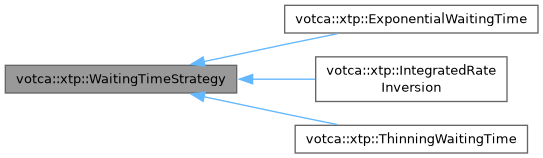
Implemented: ExponentialWaitingTime (static rates), ThinningWaitingTime (any rates with upper bounds). Template for the integrated-rate inversion for periodic rates (Prados, Brey, Sanchez-Rey, J. Stat. Phys. 89, 709 (1997); R. Paiders, BEP TU/e 2025): IntegratedRateInversion.
Definition at line 69 of file kmcwaitingtime.h.
Constructor & Destructor Documentation
◆ ~WaitingTimeStrategy()
|
virtualdefault |
Member Function Documentation
◆ ChooseHop()
◆ Name()
|
pure virtual |
◆ NextTime()
◆ Prepare()
|
pure virtual |
The documentation for this class was generated from the following file:
- xtp/include/votca/xtp/kmcwaitingtime.h
