|
| static Data | FromTopology (const Topology &top, const std::vector< QMStateType > &carriers) |
| static Data | FromNetwork (const StochasticNetwork &net, const std::vector< QMStateType > &carriers, const Eigen::Vector3d &box) |
| | the same data from a model network (validation)
|
| static std::vector< double > | NearestDistances (const std::vector< Eigen::Vector3d > &points, const Eigen::Vector3d &box) |
| | nearest neighbour distances
|
| static std::vector< double > | ContactDistances (const std::vector< Eigen::Vector3d > &points, const Eigen::Vector3d &box, Index probes, std::uint64_t seed) |
| | distances of probes random positions to the nearest point
|
| static Curve | Cdf (const std::vector< double > &x, const std::vector< double > &r) |
| | empirical distribution function on a grid
|
| static Curve | PairCorrelation (const std::vector< Eigen::Vector3d > &points, const Eigen::Vector3d &box, double bin, double rmax) |
| | pair correlation function in bins of width bin up to rmax
|
| static Curve | Correlation (const std::vector< Eigen::Vector3d > &points, const Eigen::Vector3d &box, const std::vector< double > &z, double bin, double rmax, const std::vector< char > &skip={}) |
| static double | NormalQuantile (double u) |
| | inverse of the standard normal distribution function
|
| static std::vector< Curve > | Overlaps (const std::vector< Eigen::Vector3d > &points, const Eigen::Vector3d &box, const std::vector< Index > &l, double bin, double rmax) |
| | overlap curves O_l(r) for the given l
|
| static double | FitWeights (const Curve &kappa, const Curve &Ob, const Curve &Oc, double &w_b, double &w_c) |
| static Curve | PairsPerSite (const Data &data, double bin, double rmax) |
| | pairs per site in distance bins (connected pairs of the data)
|
| static Curve | MeanLog10J2 (const Data &data, Index carrier, double bin, double rmax) |
| | mean of log10(J^2/eV^2) in distance bins
|
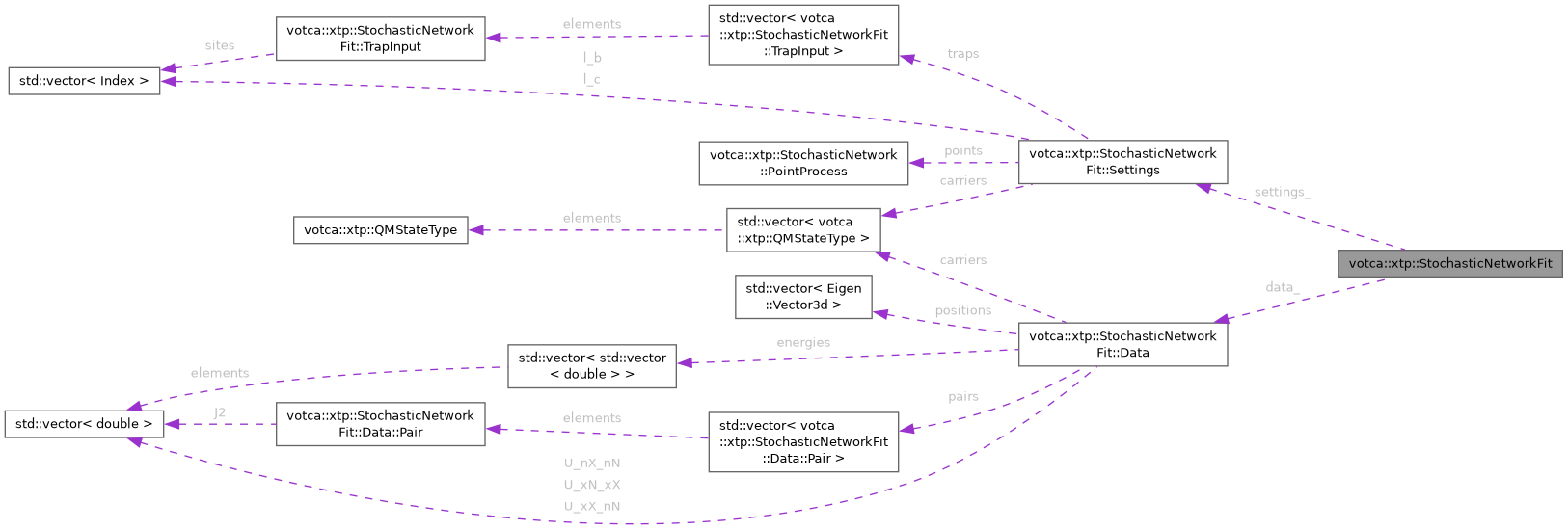
Fits the parameters of a StochasticNetwork to a microscopic system (a state file with site energies and couplings).
- Point process: hard core, mean and variance of the radii by a coarse grid and Nelder-Mead on the squared differences of the nearest neighbour distance distribution D(r), the spherical contact distribution H(r) and (weight 1/4) the pair correlation function g(r), averaged over a few realizations with fixed random numbers.
- Site energies (per carrier): mean, standard deviation and the spatial correlation kappa(r) = mean of z_i z_j over pairs at distance r. The moving average gives kappa(r) = w_b O_{l_b}(r) + w_c O_{l_c}(r), with O_l(r) the mean overlap |N_l(i) cap N_l(j)| / l of the neighbour sets of two sites at distance r, evaluated on the microscopic sites. For every (l_b, l_c) of the grids the weights (w_b, w_c >= 0, w_b + w_c <= 1) are a weighted least squares fit; the best pair is taken. The microscopic kappa is estimated with the sample mean and variance, which biases it by the mean correlation cbar = (w_a + w_b l_b + w_c l_c) / N over all pairs; the model is compared in the same form, (kappa - cbar) / (1 - cbar) (fixed point iteration), so that large model networks have the unbiased kappa; the standard deviation is corrected in the same way, sigma = s / sqrt(1 - cbar). Correlations over distances comparable to the box are not determined by the microscopic system; the fit reports when l_c is at the end of its grid. The site energies are the full site energies (electrostatic, polarization and internal).
- Connections: f(r) = (number of pairs) / (number of site pairs) in distance bins.
- Couplings (per carrier): y = log10(J^2/eV^2) linear in r, the squared residuals linear in r, quantiles of the standardized residuals.
- Two carriers: correlation of the site energies (Pearson) and of the coupling residuals (normal scores, Gaussian copula). The moving average of the second carrier is fitted to (kappa_2 - rho^2 kappa_1) / (1 - rho^2), so that the model reproduces kappa_2.
- Reorganization energies: means over the segments.
- Traps (Settings::traps, e.g. from TrapFinder): their sites are left out of the site energy statistics of all carriers (mean, sigma, kappa, carrier correlation), and each becomes a StochasticNetwork::Trap template (energies of its sites relative to the bulk mean, all carriers) with the density 1/N of the microscopic system.
Definition at line 82 of file stochasticnetworkfit.h.